Fitz Roy - Northwest face
17. Filo Noroeste (Afanassieff)
17.1 Los Últimos Días del Paraíso
17.2 Chercheur de l'Absolu
17.3 Attempt
17.4 Rocamora-Tarditti
17.5 Tango Libre
1550m 30˚ 6a+
Jean and Michel Afanassieff, Guy Abert and Jean Fabre (France), 27/12/1979. With support from Gilles Sourice (cameraman).
Description. One of the longer routes in the massif. It involves mainly moderate climbing following the line of least resistance up the northwest ridge, first on the north side of the ridge, then around on its south side, later straight up it. Expect to find some sandy and flaky rock in the first half. The crux is steep ice choked crack about 800 meters up, that is freeclimbed on the “outside”, clipping a few pins and placing a few pieces of protection on it’s side walls. It is an enjoyable climb, but except for the crux and the following pitch it has no climbing that one might consider attractive. It is a great mountain adventure, with plenty of loose blocks and fun problem solving.
History. In 1976 Jean Afanassieff and Abert unsuccessfully attempted the line with Patrice Bodin. The first ascent party fixed 300 meters of rope, then climbed the remaining 1300 meters alpine style, reaching the summit on their fourth day. On day three and four they climbed in the middle of a raging storm describing, “la ambiance est démoniaque, les cheminées se transforment en tuyère, on a l’impression de grimper avec un 747 au-dessus de la tête”. They descended the route with 45 rappels that required two days. Their ascent was a significant step forward for Patagonian climbing, a first ascent of such magnitude accomplished with so little equipment and fixed rope (six days up and down with no sleeping bags...). Apparently the movie they produced is quite good. The route has been repeated several times, with parties taking between 24 to 36 hours to reach the summit (no bivy-less ascent yet).
Jean Fabre describes the conditions, “Je n’ai jamais connu de montagne plus réberbative que le Fitz Roy un jour de tempête. Si les Grecs de l’Antiquité avaient practiqué l’andinisme, ils auraient fait siéger Eole au sommet d’El Chalten et ca puissance aurait sans doute détrôné la foudre de Jupiter...
Female ascents: Paula Alegre with a partner, 2009. First team female ascent and second team female ascent of Fitz by Milena Gomez (AR) and Dörte Pietron (DE) in 2010. Susy Tarditti (AR) via a major new variation in 1/2012 (see above). Second team female ascent and third team female ascent of Fitz by Cintia Percivati and Luciana Tessio (AR) in 2/2012. Anna Pfaff (US) and partners, 2/2012 (climbing the last 500m with a broken foot!). Third team female ascent and fifth team female ascent of Fitz Nastja Davidova and Tina Di Batista (SI) in 2/2013 (in 2004 Di Batista, together with Monika Kambic -AR/SI- had done the first team female ascent of Fitz via the Franco-Argentina link-up).
Solo ascent. In 3/2019, Jim Reynolds (US) free-soloed up and down the Afanassieff route, taking 6:38hs to reach the summit and 8:30hs to down-free-soloed the same route. He carried a rope and some gear, which he did not use, but he forgot his harness and belay device. He described his approach as the “best possible form of the art” he could come up with. A little over a week before, he also free-soloed Agujas Rafael Juárez and Saint Exúpery, up and down. On Aguja Rafael Juárez he free-soloed the complete Filo Oeste (1000m 6b) and down-free-soloed the Anglo-Americana (350m 6b), while on Aguja Saint-Exúpery he free-soloed Chiaro di Luna (750m 6b+) and down-free-soloed the Kearney- Harrington (550m 6a+).
In the early 1900s, Austrian Paul Preuss, considered by many “the father of style” had preached and practiced free-soloing up and down peaks as the “honest, sporting” way to climb (his words). He argued that one should “overcome difficulties with your own strength, on ascent and descent alike,” explaining that “if there is someplace you can’t go down, you should also not go up.” One could have never imagined that Preuss's maxims would be one day applied to a peak like Cerro Fitz Roy. One stylistic argument one can make about Jim's ascents is that they are the first free ascents of these formations. If rappels and pendulums are not considered free-climbing in a face such as El Cap, why should an ascent of a jagged peak be considered free unless the descent is also done free?
More info about Jim's free-solo ascents here.
Fast ascents. Jim Reynolds' free-solo ascent, in 6:38hs is the fastest ascent of the route. In 1/2018, Colin Haley and Austin Siadak (US) climbed the route in 10:37hs from base to top, taking 23:57 from Piedra Negra to Piedra Negra. They descended via the Francesa.
Other. In late 2015, Ermanno Salvaterra (IT) climbed the route aged 61, video here. In early 2019, Diego Miguens (AR) climbed the route aged 64. Diego's is the second oldest ascent of the peak after Martin Zabaleta (Vasque) who in early 2019 climbed the Californiana age 69.
Approach. Paso Cuadrado and Glaciar Fitz Roy Norte.
Descent. A descent along the route would be treacherous because of bad belays and endless blocks and flakes. Climbing up and over the summit to descend the Francesa is recommended.
Bibliography.
Alpinisme et Randonee 18 p. 21-25; AAJ 1981 p.238; La Montagne et Alpinisme 1980/2 p.286-293. |
Photos (click to enlarge)
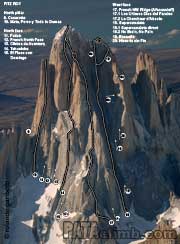 Fitz Roy north and west face 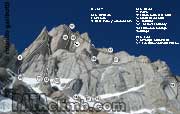
Fitz Roy north face 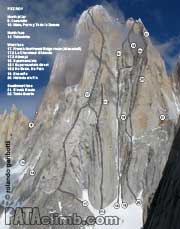
Fitz Roy west face 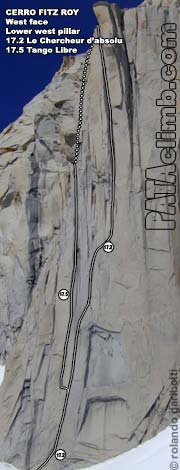
Fitz Roy west face 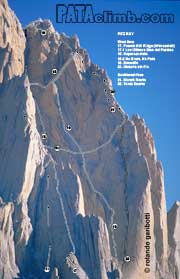
Fitz Roy west face 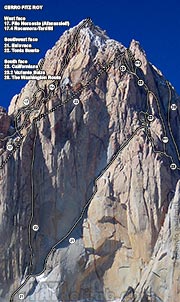
Fitz Roy southwest face 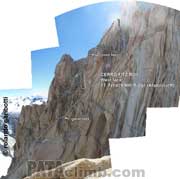
Fitz Roy west southwest facee
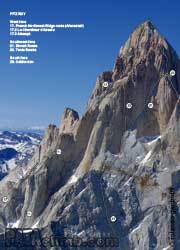
Fitz Roy southwest facee 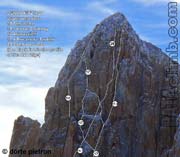 Fitz Roy north face
|
17.1 Los Últimos Dias del Paraiso
750m 30˚ 6c A2
Grega Lacen and Tomaz Jakofcic (Slovenia), 2007
Description. This route starts on a horizontal snow bench low on the north face, about 100 meters down and 300 meters right of Tehuelche’s leaning spire, just left of El Flaco con Domingo, which crosses it after three pitches or so. The first seven pitches, on slabs to the right of a big corner/chimney system that is choked with ice, are quite hard with poor rock (sandy and loose) involving free-climbing up to 6c as well as a few aid moves (A2) on icy cracks. After the first five or six pitches it is possible to move inside the corner system proper. At the end of this corner the climbing becomes easy for several hundred meters, including some easy snow climbing. The next steep section is a series of slabs immediately left of the Afanassieff involving 10 pitches with difficulties to 6a and A2. Just below the crest of the NW ridge the route joins the Afanasieff, along which it continues to the summit (700 meters more, difficulties to 6a+).
History. After the first section, Jaka and Grega’s original plan was to climb the big corner left of the Afanasieff route, but it looked quite loose so they climbed further right instead, on the slabs. They climbed alpine style, starting in the morning and climbing non-stop for 38 hours, reaching the summit in a raging storm at 10 PM on day two. Because of the bad weather the descent along the Francesa was epic. Between the approach, climb and descent their entire adventure involved 72 hours of non-stop fun. They dedicated their route to their friend Ozbej Povsod, who died in 2006.
|
17.2 Le Chercheur d'Absolu
600m 7a C2
Aymeric Clouet and Christophe Dumarest (France), 1/2008.
Description. An interesting variation to the Afanassieff that involves climbing initially a difficult and vertical pillar, located between the Afanasieff and the Supercanaleta. After those first 400 meters the route traverses almost straight left in search for easier ground and to join the Afanassieff along which it continues for another 1000 meters to reach the summit. The initial pillar involves difficulties up to 7a and A2. They estimate that it could go free at 7b/c.
History. Clouet and Dumarest fixed their two climbing ropes the evening before starting the climb and then spent two entire days climbing to the summit. They had only camalots to #3 that, made the few sections of off-width cracks that they encountered on that initial pillar, difficult. The descended the Supercanaleta. A French team had climbed this pillar in 2002 and 2003, but they intended to continue straight up, following the ridge crest, and were turned back after 800 meters by blank rock (see route 26 Attempt).
|
17.3 Attempt
Nicolas Fabbri, Jérôme Huet and Pierrick Keller (France) in 2003; the same with Véronique Barbier (France) in 2004.
Description/History. Their attempted line climbs the pillar and ridge left of the Supercanaleta. This involves a steep initial pillar, followed by a second pillar and a ridge with three very distinct towers. After that point the attempted line would join the Afanassieff at its halfway point. They fixed ropes on the first pillar, which they surmounted with difficulties to 6b/A2. The second pillar involved mixed passages to M5, one aid pitch (A2) and good free climbing to 6b/c. Some of the rock on this second pillar was of poor quality. Above the second pillar sit five little towers of about 10m each, the last one being difficult (aid). Thereafter, the line heads for three bigger towers and below the third (150m high) they retreated. There is apparently only one possible route up this third tower, a crack that is wide at the start and gets narrower and finally ends in a slab. All in all they climbed 800 meters of vertical gain. They estimated that in less than 10 more pitches they would have joined the Afanassieff Route. They left in place 10 bolts.
This attempted line was “finished” by Aymeric Clouet and Christophe Dumarest - Le Chercheur de l’Absolu - who climbed the lower half of the intended line and from there traversed off to the left, to join the Afanasieff.
|
17.5 Tango Libre.
450m 7a+
In February of 2014 Waldo Aravena, Gabriel Fava and Roberto Treu (AR) climbed the first pitch and a half of Le Chercheur d'Absolu to then head left, up a beautiful corner to rejoin Le Chercheur d'Absolu after 11 pitches, at the traverse to rejoin the Afanassieff. They started climbing in the afternoon so as to do the crux pillar in the warmest moment of the day, making an uncomfortable vivac at the top of that initial steep pillar. The next day they joined the Afanassieff along which they reached the summit on their third day on the wall. The crux pitch is the very first one, in common to Le Chercheur d'Absolu a series of flakes to reach a crack system, with the first piece of protection being 5 meters of the ground.
Earlier in the season Fava, with Iñaki Coussirat and Carlos Molina had made an attempt on a line between Le Chercheur d'Absolu and Tango Libre, retreating after six pitches.
|