Cerro Marconi Sur & Aguja Dumbo.
General description.
The group of mountains that close the Electrico valley are called Marconi range and were christened by Alberto Maria De Agostini in honor of the Guglielmo Marconi (1874-1937), an Italian electrical engineer who was partly responsible for the development of wireless telegraphy and was also the President of the “Regia Accademia d’Italia”, which partly supported De Agostini’s expedition. The river that flows down valley from those peaks that are named after an electrical engineer was fittingly named Rio Electrico.
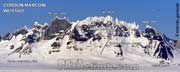
The first to view these peaks were the members of the 1916 Buenos Aires Sociedad Cientifica Alemana expedition, led by Alfredo Kolliker, who during the first ever traverse across the Hielo Continental were able to see the western flank of what later became Cordón Marconi. More practical and less eager to celebrate European heroes and sponsors than De Agostini, they named the mountain after its likeliness, calling it Cerro El Cajon (box peak) after the square shape that Marconi Central has when viewed from the west.
The Marconis suffer the same fate that most non-granite peaks succumb to in this area, which is that they receive little to no attention. There have been a number of ascents of Marconi Norte, but Marconi Central remains unclimbed and Marconi Sur has but one ascent. This happens in the Paine massif as well, where beautiful Paine Grande has only had two ascents in 50 years, while well trodden routes on the North Tower get a handful of repeats per year.
Climbing history.
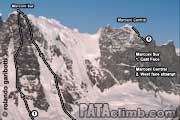
In spite of being the highest of the three, Marconi Sur has only had two ascents to date. It is a very imposing peak that certainly deserves more attention than what it has gotten so far.
1. Cara Este
80° 5+.
Antonio Taglialegne (IT), 3/1995.
Description. Follows the east buttress. The rock quality isn’t great.
History. Taglialegne’s was the first ascent of the peak. He bivied once, while descending, in a col just north of the summit. He self-belayed only one pitch, a steep tower near the summit, where he placed two pitons.
Approach. Glaciar Marconi.
Descent. Taglialegne descended via the snow slope just north of the buttress he climbed.
2. West Face attempts
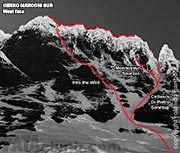
In 1982 Argentines Pablo Cottescu, Oscar Di Pietro and Jorge Sonntag climbed a couloir (to 70°) on the west face to a col south of the summit, between this and a huge snow mushroom. Bad weather forced them to retreat from that point, 150 meters below the summit. From the col they estimated 5 pitches of mixed rock and ice to the summit. To descend they made two rappels and down climbed the rest. They approached via Paso Marconi.
In October of 1999 French Laurence Monnoyeur and Bruno Sourzac climbed the same couloir mentioned above but before reaching the col they climbed left into a left leaning couloir and after two pitches (to 85º) they found a difficult section involving rotten ice so they decided to retreat. They made three rappels to descend.
3. Into the Wild
In May of 2015 Markus Pucher (AT) made the second ascent of Cerro Marconi Sur climbing a line in the center of the west face. "Into the Wild” climbs 800 meters with difficulties to M5. He free-soloed up and down, starting from a camp on the Icecap (1500m approx.) and taking a mere six hours roundtrip (2:50 hs up).
Aguja Dumbo.
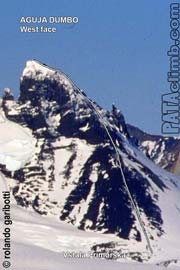
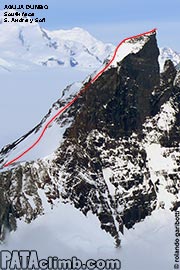
Aguja Dumbo is located just south of Marconi Sur and is named after its curious resemblance to an elephant’s ear. It is still unclimbed. Expect mediocre rock.
4. Vstala Primorska
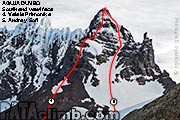
In mid November 2013 Dejan Koren and Boštjan Mikuž (SI) completed the first ascent of Aguja Dumbo, a big fin like tower at the southern end of the Marconi range. A 400 meter approach on snow slopes to 60° leads to several mixed pitches, a first one (M6) through a gully leads to a section with steep ice and rock (to 85° - M5). More easy snow leads to another steep section (to 85° and M4) and a final snow ridge that gives access to the summit (ca. 2465m). In all the route has around 400 meters of technical climbing (1000m of vertical gain from the flat glacier to the summit). To descend they made seven rappels, first along the line of ascent, then heading climber's right to reach easy snow slopes that can be dowclimbed. They named the route Vstala Primorska, the name of a Second World War song that celebrates the rise and fight of the Primorska province in the western part of Slovenia, from where the first ascensionists hail.
5. André y Sophie
Henry Bizot (FR) - Gabriel Fava (AR), 11/2015. It follows the most obvious line up the peak, the line of weakness, climbing snow and ice with short mixed climbing sections (600m 65° M3). The name refers to a friend of Henry's who has a terminal illness. They approached from a camp in the Ice Cap.
|